

World Insights: Wide
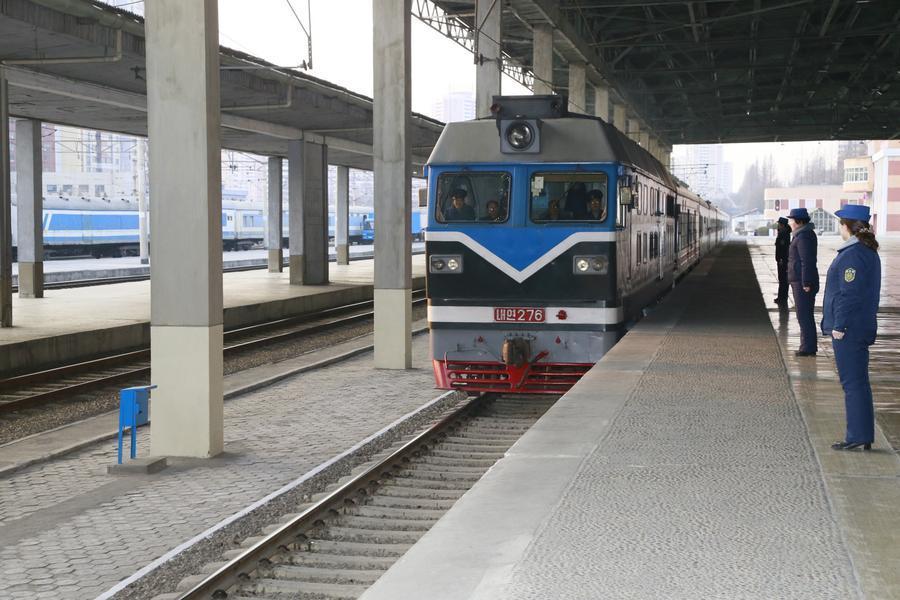
An international passenger train from Dandong of China to Pyongyang of the Democratic People's Republic of Korea (DPRK) arrives in Pyongyang, the capital of the DPRK, March 12, 2026. (Xinhua/Wang Chao)
In recent years, under the strategic guidance of the top leaders of the two parties and the two countries, China-DPRK traditional friendly and cooperative relations have maintained sound and steady development.
BEIJING, June 7 (Xinhua) -- Xi Jinping, general secretary of the Communist Party of China Central Committee and Chinese president, will pay a state visit to the Democratic People's Republic of Korea (DPRK) from June 8 to 9, his first state visit to the country in seven years, at the invitation of Kim Jong Un, general secretary of the Workers' Party of Korea and president of the State Affairs of the DPRK.
This year marks the 65th anniversary of the signing of the China-DPRK Treaty of Friendship, Cooperation and Mutual Assistance. In recent years, under the strategic guidance of the top leaders of the two parties and the two countries, China-DPRK traditional friendly and cooperative relations have maintained sound and steady development.
Exchanges and cooperation in areas including the economy, culture, education, and youth affairs have produced fruitful outcomes, delivering benefits to both countries and their peoples, injecting new vitality into the traditional friendship between the two nations, and making positive contributions to regional peace and development.
ECONOMIC AND TRADE COOPERATION
On May 4, the 24th Pyongyang Spring International Trade Fair opened at the Pyongyang Central Youth Hall, where Chinese products on display proved popular among DPRK visitors.
Yun Jong Ho, the DPRK's minister of external economic relations, toured some booths operated by Chinese enterprises.
Noting that the DPRK continues to make new progress in the era of comprehensive socialist development, Yun extended a warm welcome to outstanding Chinese enterprises attending the fair and expressed confidence that the two sides will further expand exchanges and cooperation in economy, trade and other fields, contributing to their respective economic and social development.
In recent years, China-DPRK economic and trade cooperation has shown a positive development momentum. According to Chinese official statistics, bilateral trade volume reached 2.735 billion U.S. dollars in 2025.
The Guomenwan trade zone in Dandong, a city in northeast China's Liaoning Province, has witnessed increasingly close economic and trade exchanges between China and the DPRK. In 2025, the zone recorded 168 million yuan (24.8 million dollars) in imports through border residents' trade, with a total of 22,000 participants engaged in such transactions over the course of the year.
Zhang Xu, an official with the trade zone, said that during this year's May Day holiday, Chinese representatives from the trade zone participated in an international exhibition in the DPRK, and held talks with more than 30 DPRK enterprises. Since May, "representatives from DPRK trading companies have been coming to talk with us almost every weekend," Zhang said.
Liang Tongjun, president of the China Chamber of Commerce in the DPRK, said that as an important vehicle for non-governmental economic and trade exchanges, the chamber is willing to promote mutual understanding and affinity between the two peoples through economic and trade cooperation, as well as cultural and people-to-people exchanges.
Zhang Huizhi, deputy director of the Northeast Asian Research Center at Jilin University, said that practical cooperation between China and the DPRK across economic, social and other fields will further promote bilateral and multilateral cooperation in the region, contributing to the stability and prosperity of Northeast Asia.
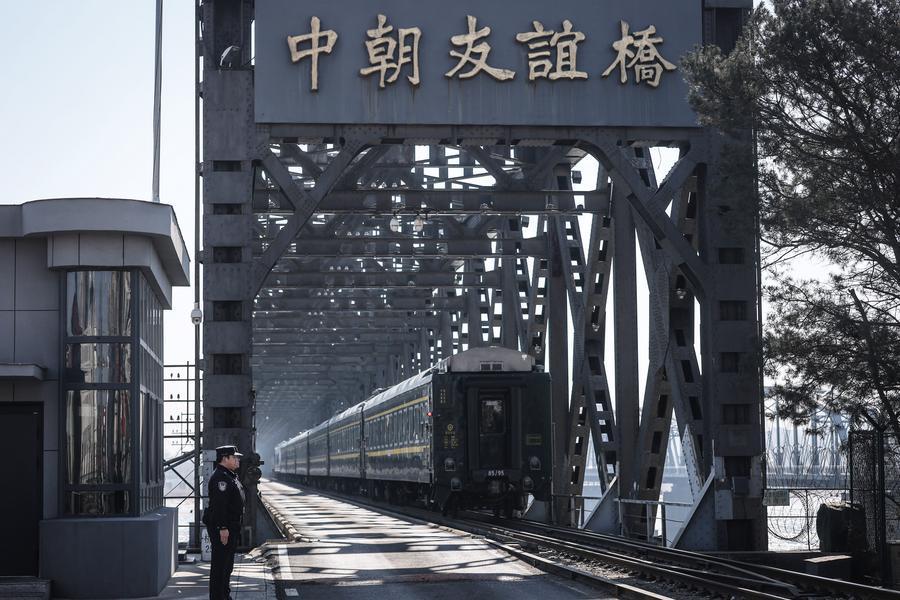
The train No. 95 from Dandong of China to Pyongyang of the Democratic People's Republic of Korea (DPRK) passes a border bridge in Dandong, northeast China's Liaoning Province, March 12, 2026. (Xinhua/Pan Yulong)
PEOPLE-TO-PEOPLE CONNECTIVITY
On March 12, an international passenger train from Dandong arrived in Pyongyang, marking the resumption of international passenger train services between China and the DPRK.
On March 30, an Air China passenger plane from Beijing arrived at Pyongyang International Airport, signaling the formal resumption of the Chinese carrier's passenger flight operations between the capitals of China and the DPRK. Road, rail and air links between the two countries have all been resumed thus far.
China State Railway Group Co., Ltd. said that the international passenger train serves not only as an important channel for cross-border travel, but also as a dynamic link of friendship between the two countries, adding that it will further facilitate personnel exchanges and promote people-to-people connectivity.
Cultural and artistic exchanges are an important component of China-DPRK friendship and serve as a key means of fostering mutual understanding and emotional connection between the two peoples. Multiple Chinese films have received awards at the Pyongyang International Film Festival, while the DPRK's April Spring Friendship Art Festival has repeatedly invited Chinese art troupes to participate.
The year 2024 marked the 75th anniversary of diplomatic ties between China and the DPRK, as well as the China-DPRK Friendship Year.
At the opening ceremony of the China-DPRK Friendship Year, artists from both countries presented their long-standing and distinctive cultural traditions through refined performances, expressing the two peoples' sincere hope to carry forward and promote their traditional friendship, which resonated strongly with the audience.
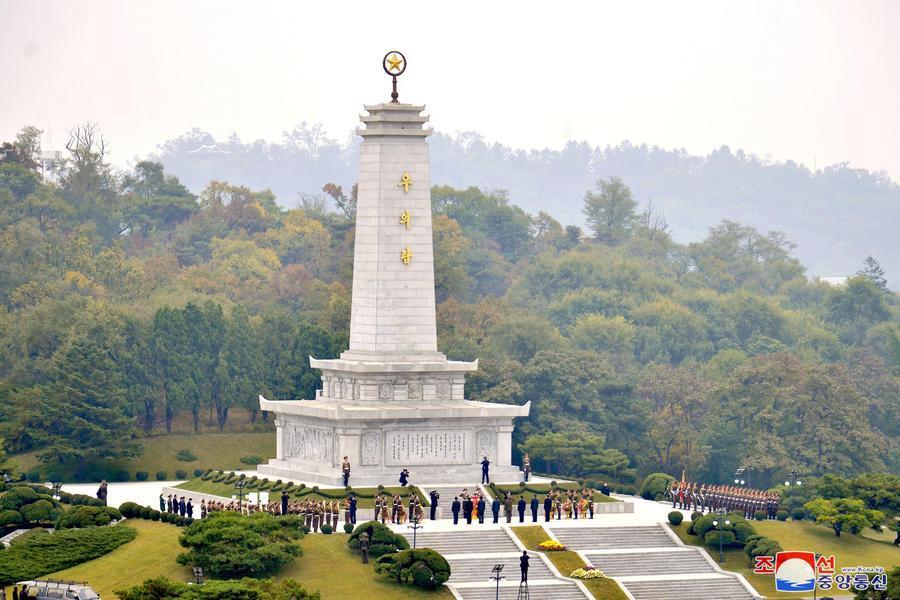
Photo provided by the Korean Central News Agency (KCNA) shows a ceremony to present flower baskets at the Friendship Tower in Pyongyang, the Democratic People's Republic of Korea (DPRK), Oct. 21, 2020. (KCNA/Handout via Xinhua)
YOUTH EXCHANGES
The Grand People's Study House, located in Pyongyang's Kim Il Sung Square, is an important documentation center and a hub for social and cultural education in the DPRK. It has long been offering Chinese language training courses, with each session attracting as many as 600 to 700 students. The institution said Pyongyang citizens have shown strong enthusiasm for learning Chinese.
Huang Li, a Chinese language teacher from Liaodong University, northeast China's Liaoning Province, has taught at Pyongyang University of Foreign Studies on three occasions and has developed a deep friendship with local teachers and students.
She has taught over 1,000 students, who have become an important force in promoting China-DPRK traditional friendship and advancing exchanges between the two countries.
According to the plan, Huang will return to the DPRK to teach in the second half of this year. "This time, in addition to Chinese language instruction, I hope to offer practical courses in areas such as economy, trade, tourism and law, to help cultivate interdisciplinary and application-oriented talent," she said.
The Pyongyang University of Science and Technology resumed hosting the Chinese Proficiency Test (HSK) in 2025. During a meeting with Chinese Ambassador to the DPRK Wang Yajun, Choe Ryong Ho, the university's vice rector, said that Chinese language education at the university has been developing steadily, and the university will continue to improve Chinese teaching, with the aim of further strengthening practical cooperation and talent exchanges with relevant Chinese universities.
Niu Xiao, a lecturer at the School of Government of Shanghai University of Political Science and Law, once studied in the DPRK. In late August last year, she was invited by Kim Il Sung University to attend an international academic seminar in Pyongyang.
"That was both an academic journey and a vivid experience of witnessing China-DPRK traditional friendship and the DPRK's economic and social development," Niu said. She observed a significant increase in the number of private cars on the streets of Pyongyang and greater diversification in local payment methods.
In early May this year, 70 Chinese government scholarship students from 16 universities across China arrived in Pyongyang to begin their studies at prestigious DPRK universities such as Kim Il Sung University and Kim Hyong Jik University of Education.
"Studying in the DPRK allows us to more deeply appreciate the vibrant vitality of China-DPRK traditional friendship," Gu Dian, a student from Shanghai International Studies University, told Xinhua.
"We will transform what we have learned in the DPRK into concrete actions to promote China-DPRK friendship, ensuring that the people-to-people and cultural exchanges between the two countries are passed down from generation to generation," said Gu.
(责任编辑:{typename type="name"/})
- ·中国女排3:0击败菲律宾队 迎亚运开门红
- ·情人节前一天和当天送花有何不同?
- ·砍掉网红“孤独树”,村民梁亚利:麦田被踩没人赔,要保护庄稼
- ·梅雨季如何延长花期?
- ·钟南山:目前这种病毒全世界没有特效药
- ·原油交易提醒:伊朗暂停谈判加剧供应担忧,油价低位反弹
- ·多头玫瑰与单头玫瑰的区别有哪些?
- ·一线调研丨算力网织就数字经济新底座
- ·解放军仪仗司礼大队仪仗分队参加纪念苏联伟大卫国战争胜利80周年阅兵活动
- ·一张图:波罗的海指数小幅走低,海岬型船舶运费下降
- ·伊朗消息人士称美伊将举行视频会议并签署协议
- ·一线调研丨算力网织就数字经济新底座
- ·黄金交易提醒:美联储鹰派打压金价,油价回落却引爆反弹,抄底还是观望?
- ·三八节送不同数量玫瑰花的含义是什么?
- ·情人节求生手册:送错花时如何挽回局面?
- ·National Library of China launches month