

Economic Watch: Western China becomes new hotspot for global businesses
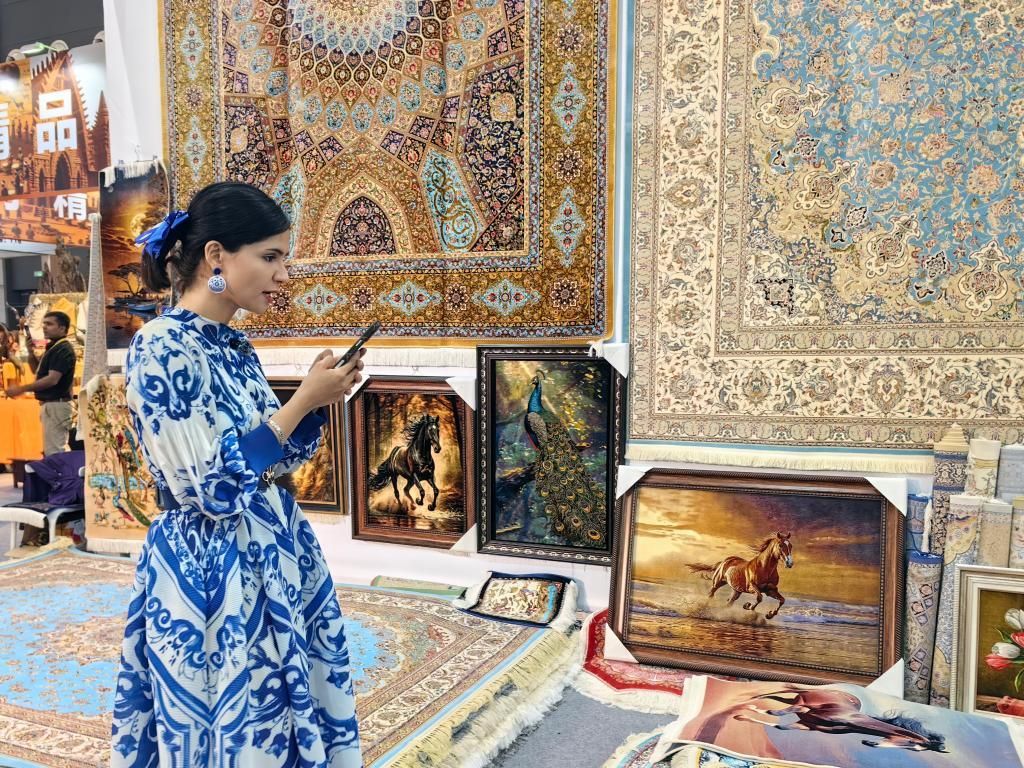
A staff member introduces products via livestreaming at the booth of Iran during the 10th Silk Road International Exposition in Xi'an, northwest China's Shaanxi Province, May 21, 2026. (Xinhua/Zhang Sijie)
XI'AN, May 25 (Xinhua) -- At the Iranian section of the 10th Silk Road International Exposition, ornate carpets, delicate handicrafts and essential oils drew a steady stream of visitors. Nearby, an Iranian salesman was seen livestreaming products to Chinese shoppers via an e-commerce app.
For Iranian exhibitor Mahdi Barid Olyaei, the expo represented more than just a trade fair. Attending the event in Xi'an, northwest China's Shaanxi Province, for the second time, he brought an expanded product lineup.
"We've mainly cooperated with partners in eastern China in the past. Western China represents a new market for us. We hope to better understand local consumption habits and expand our presence by connecting directly with buyers and finding more wholesale partners through the expo," Olyaei said.
Olyaei's enthusiasm was echoed by many other international participants. The five-day expo, which concluded on Monday, attracted nearly 200 overseas enterprises from 64 countries and regions. Many shared the same view that the fair serves as a gateway to the booming market in western China.
Covering 72 percent of the country's land area and home to 27 percent of its population, western China is increasingly emerging as a new frontier for opening up. The momentum is supported by China-Europe freight train services and the New International Land-Sea Trade Corridor, both of which are enhancing regional connectivity.
In the first quarter of this year, China-Europe freight trains to and from Xi'an completed 1,631 trips, up 7.4 percent year on year, accounting for nearly 30 percent of the national total. Meanwhile, shipping time has been shortened significantly, with the fastest trains reaching Germany in just 10 days and Central Asia in just five days.
Beyond facilitating trade, enhanced connectivity is enabling logistics providers, manufacturers and port operators to build more integrated industrial chains and share development opportunities.
According to Evgenii Nikitin, CEO of Russia's aluminum giant Rusal, the company has established a branch in Xi'an as the city now handles more than 40 percent of its aluminum rail shipments to China.
Foreign businesses can also find a niche in western China, leveraging the region's diverse resource advantages and sound industrial ecosystems. At the Sichuan exhibition area of the expo, a high-resolution optical satellite developed by Huantian Wisdom Technology Co., Ltd. stood out.
With a spatial resolution of 0.5 meters, the satellite functions like a camera in space, providing detailed geographic data for farmland monitoring, ecological protection and disaster prevention.
"Uzbekistan's officials are interested in leveraging our service framework to provide satellite data and technical solutions for their country," said Ji Muye, head of the company's international business division.
This growing appeal is further reinforced by policy support. China's revised catalog of encouraged industries for foreign investment, which took effect in February, underscores the country's commitment to attracting global investment in key areas such as advanced manufacturing and green development, with a particular focus on China's central, western and northeastern regions.
At the local level, governments are also tailoring foreign investment priorities to match their own industrial strengths while exploring opportunities in emerging sectors. Southwest China's Chongqing, for example, encourages research, development and manufacturing of small- and medium-sized agricultural machinery suited to mountainous terrain, while Guizhou has expanded support for hardware and software of computing infrastructure.
Pan Yuanyuan, a researcher at the Institute of World Economics and Politics of the Chinese Academy of Social Sciences, said the differing demands of eastern and western China create diverse opportunities for foreign companies.
"Companies with different strengths can all find suitable market segments, and highly specialized niches often contain unexpected business opportunities," she said. ■
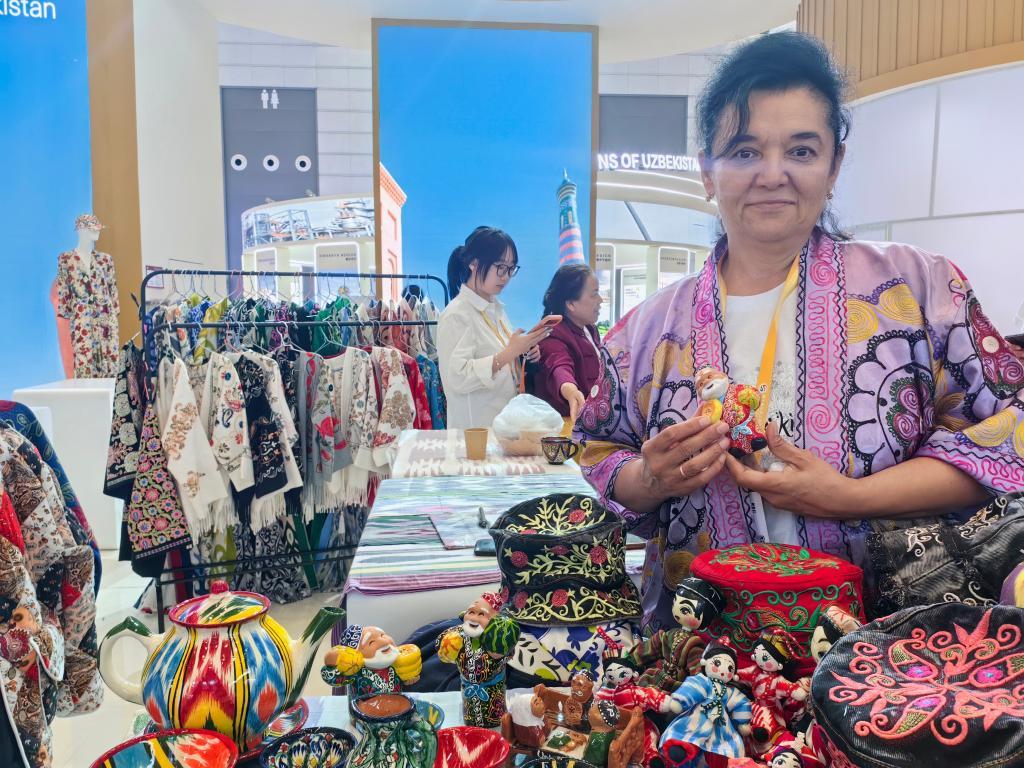
An exhibitor from Uzbekistan shows her products during the 10th Silk Road International Exposition in Xi'an, northwest China's Shaanxi Province, May 21, 2026.(Xinhua/Zhang Sijie)
(责任编辑:{typename type="name"/})
- ·视频丨伊朗大中小学复课 遭袭米纳卜小学却不会重开
- ·男同事结婚送什么花最好?
- ·今年七夕节你的花店赚钱了吗?
- ·投资772亿的国家工程 开工仪式不到15分钟 三峡水运新通道工程开工传递低调务实作风
- ·能源冲击下全球央行紧缩潮在重启
- ·有钱花为何受人喜爱?
- ·“云海之舟”18年94万公里零事故 “机器会老化,但安全意识绝不能生锈”
- ·欧元区:增长没了,通胀高了,加息还来吗?
- ·视频丨伊朗大中小学复课 遭袭米纳卜小学却不会重开
- ·碎冰蓝玫瑰可以和红玫瑰混搭吗?
- ·中国光谷3551国际创业大赛开启报名 巅峰十强各奖100万元
- ·首粒进球首张红牌首场胜利 揭幕战诞生三项第一
- ·坚持与担当 老将矢志续写亚运荣光
- ·伊核谈判逆转、全球PMI走弱、联储鹰派信号三重压力共振,美元升至六周高点
- ·六网织就新未来丨通信网护航空中“高速路” 赋能产业新发展
- ·巴基斯坦总理:伊朗和美国已就协议文本达成一致